Over the past two years since The Anzac Legend was first published (boy, that's gone quick!) I've had some feedback which has made me look at changing the book from landscape to portrait format.
I chose the original landscape format because it was the best for showing the broad maps which are a large part of the books success, but the portrait format is the preferred format for book-sellers and libraries to display the book on their shelves. After some initial trials I found that I could rearrange the panels without too much hassle.
It is a slow process, and a slight reduction in panel sizes, but generally I'm pleased with the result, and the pages look good.
Some pages are not as easily or neatly arranged as the panels are of various sizes and shapes; but with a little work I manage to get them together OK.
.
Showing posts with label Anzac. Show all posts
Tuesday, 26 April 2016
Monday, 20 April 2015
The ANZAC Plan
A century ago the ANZACs were preparing to land on the Gallipoli Peninsula, north of Gaba Tepe, while the British and French were planning to land at the mouth of the Dardenelles at Cape Helles and Kum Kale.
They were planning to land on the 23rd of April 1915, as this would give the Covering Force more time to land safely in the darkness between moon set and dawn. The threat of enfilading fire on the landing beach from Gaba Tepe concerned General Birdwood, so this would be mitigated by landing in darkness.
Then on the 20th of April, a strong storm blew in and kicked up the water in Mudros Harbour. It became too dangerous for the the required transfers between the troopships, so the landing was put off.
Now they waited for the wind to die down. With each succeeding day the moon set later and reduced the time of darkness for the landing of the Covering Force. If they waited too long the moon would set after dawn and there would be no chance of surprising the waiting Turks. Birdwood's plan would be ruined. He waited anxiously.
![]() |
| The British 29th Division was to land at the beaches code named S, V, W, X and Y. |
![]() |
They were planning to land on the 23rd of April 1915, as this would give the Covering Force more time to land safely in the darkness between moon set and dawn. The threat of enfilading fire on the landing beach from Gaba Tepe concerned General Birdwood, so this would be mitigated by landing in darkness.
Then on the 20th of April, a strong storm blew in and kicked up the water in Mudros Harbour. It became too dangerous for the the required transfers between the troopships, so the landing was put off.
Now they waited for the wind to die down. With each succeeding day the moon set later and reduced the time of darkness for the landing of the Covering Force. If they waited too long the moon would set after dawn and there would be no chance of surprising the waiting Turks. Birdwood's plan would be ruined. He waited anxiously.
Tuesday, 14 April 2015
Preparations for the Anzac Landing
100 years ago - the Allied forces (British and French) gathered in Mudros harbour, Lemnos Island and prepared for the upcoming invasion of the Gallipoli peninsula.
Friday, 3 April 2015
4th April 1915
In Egypt one hundred years ago, on the 4th of
April 1915, the 1st Australian Division and the units of New Zealand
Expeditionary Force who combined to make the Australian and New Zealand Army
Corps (ANZAC) were at this commencing to sail northwards across the Mediterranean
Sea from Alexandria. Their destination was Lemnos Island .
(Much of this is covered on page 15 of my book.)
![]() |
| NZ's and Australian's confront the Redcaps at "The Battle of the Wozza" |
The long awaited orders to move to the Front had finally
arrived on the 1st of April. After the “Battle
of the Wozzer” described in an earlier post (here) the soldiers got on with the task of dismantling their tents and
organising their gear for transport to Alexandria .
Piles of kit bags, etc grew beside the road at Mena and Zeitoun. The once busy areas
occupied by these units were now deserted. Arab shopkeepers who had set up
their shops outside the camps (an occurrence still happening today outside our
camps overseas) looked on bewildered, as the respective areas were tidied, emu
bobbed and the rubbish burnt in big pits. The members of the Australian Light Horse and NZ
Mounted Rifles asked enthusiastically when they would be going as well. But all
they got was a shake of the head; for, at this moment, only the infantry brigades
were moving. Men who had been using excuses to exempt themselves from certain
duties (malingering) were seen to be lining up in front of their unit RAP’s in the
hope of being found fit to go with their units. Nobody wanted to miss out on
the adventure, and get away from Egypt.
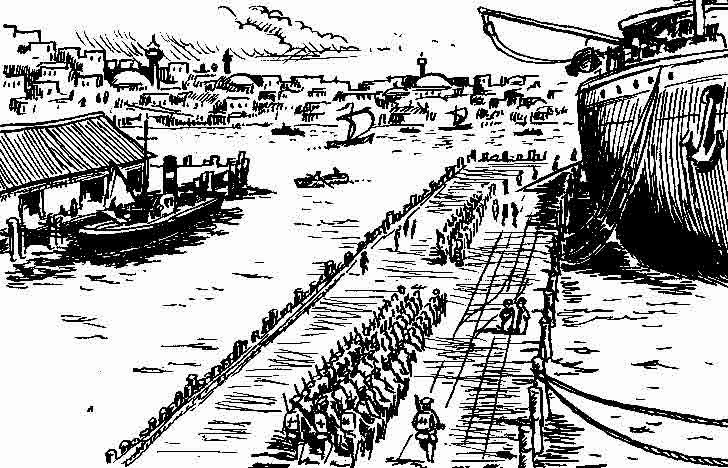
![]() |
| Troops embarking at Alexandria. |
Throughout the night and morning of the 3rd of
April as the time for the first few units to move arrived, the men formed up and marched
off to the Cairo
train station. It took four days to move the entire 1st Division
from Mena Camp, leaving only the 3rd Light Horse Brigade, the 4th
Light Horse Regiment, and a few other small units.
The news was splashed across the Cairo newspapers. Security was out the door.
The whole world, including the enemy, soon new that ANZAC was moving. The men
crammed onto troop trains at Cairo and were soon
enroute to Alexandria .
The British and French navies so dominated the Mediterranean
that the ships sailed without an escort.
This proved to be sufficient, for there were not many
instances where the Allied troop movements were threatened. On one occasion however
on the 17 April, as the SS Manitou, carrying
British 29th Division artillery units, was a day out from Lemnos, a
Turkish torpedo boat, the Timur Hissar,
slipped through the “net” and drew alongside. It was a time when chivalry still
existed; a Turkish voice shouted “I’ll give you ten minutes to leave the ship,
then I will sink you.” With that the troops aboard began to hastily man the
life boats.
One boat with sixty men aboard crashed heavily into the sea
smashing itself to pieces and 53 men drowned. As it turned out the Turkish
torpedo boat fired three torpedoes and they all missed, then some British
destroyers arrived and chased it off.
Thus it was that ANZAC was taking the last steps towards its
ultimate fate.
Friday, 13 March 2015
Lead up to the Gallipoli Campaign
At this moment, one hundred years ago, Feb / March 1915 - the Allies were involved in a naval
assault against Turkey at the Dardanelles. The intention was to force a passage through
to the Sea of Marmora . Once there, they would sail to
Constantinople (now Istanbul ) and threaten the
very heart of the Ottoman Empire (Turkey ). The envisioned result was
that the Turks would surrender and withdraw from the war.
This plan was the result of a number of factors which were
to give birth to the Gallipoli Campaign:
-
- In the Caucasus region, Turkey
was also pressuring Russia ,
who appealed to Britain
for help.
- Opening up the Dardanelles would allow Russia access to the rest of the world via their
warm water ports in the Black Sea .
-The Allies considered the Ottoman
Empire an easier opponent to fight than the other members of the
Central Powers.
- Britain
had the most powerful navy in the world, but it was restricted in its attempts
to engage the Germans, who were avoiding contact. So the Royal Navy eagerly awaited an opportunity to
be employed more fully.
- Greece ,
Bulgaria and Romania were at present sitting on the fence, so
an Allied victory over Turkey
had the highly possibility of enticing them to join the Allies to fight the
Central Powers.
British First Admiral of the Fleet, Lord Jackie Fisher, was
champing at the bit to get his ships into action. He had a plan for a direct naval
attack on Germany , with
Russian divisions being landed via the Baltic Sea .
There was also a plan for the navy to aid a landing in Belgium to
outflank the German trenches on the Western Front.
But then Winston Churchill (Britain ’s First Lord of the Admiralty) had the idea to attack the Dardanelles .
As early as 1906 the British General Staff had considered
operational strategies to attack Turkey by means of a combined Army
and Naval assault; but the plan was not recommended.
Now in 1915, the idea of a
combined assault was dismissed because of a lack of man-power. The majority of
troops were needed for the fighting in Europe, and only garrison forces were
available for the Mediterranean .
Churchill was dead-set on using the Navy to carry out the
task, and was convinced that his big ships with big guns could reduce the
Turkish forts in the Dardanelles . Most Naval
men abhorred the idea of an attack by sea alone, but eventually Churchill’s
persistence and enthusiasm won a few followers.
Eventually even Lord Kitchener
thought it worth a go; especially as it meant not robbing any of his troops
from the Western Front. If troops were required to fill any occupation role he
considered General Birdwood’s Anzacs, who were already in Egypt .
Lord Fisher’s plan was shelved.
So on the 19th of February 1915, the combined
British and French Navies commenced operations to penetrate the Dardanelles .
Monday, 5 January 2015
Comicoz Award
The Anzac Legend has received an award......
the Comicoz Award for Best Australian Original Comic Book 2014.
Follow this link to read all about it
http://www.comicoz.com/
the Comicoz Award for Best Australian Original Comic Book 2014.
Follow this link to read all about it
http://www.comicoz.com/
Subscribe to:
Posts (Atom)