I have come across this fantastic book by Mr Mesut Uyar called "The Ottoman Defence Against The Anzac Landing" published 2015.
This is the book I was looking for while I was researching The Anzac Legend. It's a pity it was published after my book. It gives great insight into the Ottoman Army and it's pre-Great War development.
Of most interest to me was the revelations of Kemal's movements during the day of 25 April 1915, and also the involvement of the 72nd and 77th Regiments. Previous books I've read did not clearly and sensibly outline these important parts of the battle.
I recommend this book to anyone who wants the latest good oil on the Ottoman Army side of the battle. Apart from all the background info, unfortunately it only covers the day of the Landing in detail.
Sunday, 13 March 2016
Saturday, 24 October 2015
Book feedback
I recently received an email from Baron Tonis Breidel Hadjidemetriou, M.A., Ph.D. ( a Cypriot historian living in Greece) who was kind enough to write to me telling me of his thoughts on The Anzac Legend. Follow the link to read what he has to say :
http://wotsleftbooks.weebly.com/testimonials.html
Friday, 24 April 2015
Monday, 20 April 2015
The ANZAC Plan
A century ago the ANZACs were preparing to land on the Gallipoli Peninsula, north of Gaba Tepe, while the British and French were planning to land at the mouth of the Dardenelles at Cape Helles and Kum Kale.
They were planning to land on the 23rd of April 1915, as this would give the Covering Force more time to land safely in the darkness between moon set and dawn. The threat of enfilading fire on the landing beach from Gaba Tepe concerned General Birdwood, so this would be mitigated by landing in darkness.
Then on the 20th of April, a strong storm blew in and kicked up the water in Mudros Harbour. It became too dangerous for the the required transfers between the troopships, so the landing was put off.
Now they waited for the wind to die down. With each succeeding day the moon set later and reduced the time of darkness for the landing of the Covering Force. If they waited too long the moon would set after dawn and there would be no chance of surprising the waiting Turks. Birdwood's plan would be ruined. He waited anxiously.
![]() |
| The British 29th Division was to land at the beaches code named S, V, W, X and Y. |
![]() |
They were planning to land on the 23rd of April 1915, as this would give the Covering Force more time to land safely in the darkness between moon set and dawn. The threat of enfilading fire on the landing beach from Gaba Tepe concerned General Birdwood, so this would be mitigated by landing in darkness.
Then on the 20th of April, a strong storm blew in and kicked up the water in Mudros Harbour. It became too dangerous for the the required transfers between the troopships, so the landing was put off.
Now they waited for the wind to die down. With each succeeding day the moon set later and reduced the time of darkness for the landing of the Covering Force. If they waited too long the moon would set after dawn and there would be no chance of surprising the waiting Turks. Birdwood's plan would be ruined. He waited anxiously.
Tuesday, 14 April 2015
Preparations for the Anzac Landing
100 years ago - the Allied forces (British and French) gathered in Mudros harbour, Lemnos Island and prepared for the upcoming invasion of the Gallipoli peninsula.
Friday, 3 April 2015
4th April 1915
In Egypt one hundred years ago, on the 4th of
April 1915, the 1st Australian Division and the units of New Zealand
Expeditionary Force who combined to make the Australian and New Zealand Army
Corps (ANZAC) were at this commencing to sail northwards across the Mediterranean
Sea from Alexandria. Their destination was Lemnos Island .
(Much of this is covered on page 15 of my book.)
![]() |
| NZ's and Australian's confront the Redcaps at "The Battle of the Wozza" |
The long awaited orders to move to the Front had finally
arrived on the 1st of April. After the “Battle
of the Wozzer” described in an earlier post (here) the soldiers got on with the task of dismantling their tents and
organising their gear for transport to Alexandria .
Piles of kit bags, etc grew beside the road at Mena and Zeitoun. The once busy areas
occupied by these units were now deserted. Arab shopkeepers who had set up
their shops outside the camps (an occurrence still happening today outside our
camps overseas) looked on bewildered, as the respective areas were tidied, emu
bobbed and the rubbish burnt in big pits. The members of the Australian Light Horse and NZ
Mounted Rifles asked enthusiastically when they would be going as well. But all
they got was a shake of the head; for, at this moment, only the infantry brigades
were moving. Men who had been using excuses to exempt themselves from certain
duties (malingering) were seen to be lining up in front of their unit RAP’s in the
hope of being found fit to go with their units. Nobody wanted to miss out on
the adventure, and get away from Egypt.
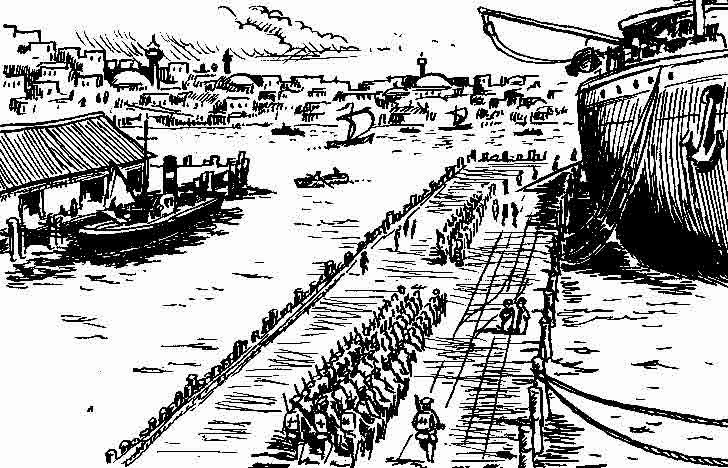
![]() |
| Troops embarking at Alexandria. |
Throughout the night and morning of the 3rd of
April as the time for the first few units to move arrived, the men formed up and marched
off to the Cairo
train station. It took four days to move the entire 1st Division
from Mena Camp, leaving only the 3rd Light Horse Brigade, the 4th
Light Horse Regiment, and a few other small units.
The news was splashed across the Cairo newspapers. Security was out the door.
The whole world, including the enemy, soon new that ANZAC was moving. The men
crammed onto troop trains at Cairo and were soon
enroute to Alexandria .
The British and French navies so dominated the Mediterranean
that the ships sailed without an escort.
This proved to be sufficient, for there were not many
instances where the Allied troop movements were threatened. On one occasion however
on the 17 April, as the SS Manitou, carrying
British 29th Division artillery units, was a day out from Lemnos, a
Turkish torpedo boat, the Timur Hissar,
slipped through the “net” and drew alongside. It was a time when chivalry still
existed; a Turkish voice shouted “I’ll give you ten minutes to leave the ship,
then I will sink you.” With that the troops aboard began to hastily man the
life boats.
One boat with sixty men aboard crashed heavily into the sea
smashing itself to pieces and 53 men drowned. As it turned out the Turkish
torpedo boat fired three torpedoes and they all missed, then some British
destroyers arrived and chased it off.
Thus it was that ANZAC was taking the last steps towards its
ultimate fate.
Thursday, 19 March 2015
Battle for the Dardanelles 18 Mar 1915
100 years ago : following on from the last post
![]() |
| Photo taken from Fort No 1 on the tip of Cape Helles; showing the mouth of the Dardenelles. |
![]() |
| This a model of Killid Bahr Fort (a typical example of the forts guarding the Narrows). You can see how strongly built they are by comparing the thickness of the walls with the width of the road. |
Just before the battle began Vice Admiral Carden became ill,
so Vice Admiral J. de Robeck took command.
The forecast for 18 March was for fine weather, so orders
were given for the armada of French and British battleships to form and
commence the attack at 11 o’clock that morning.
During the earlier operations at the beginning of March, the
Turks had observed that the Allied ships had a tendency to sail towards the
Narrows and then turn to starboard into Erin Keui Bay , on completion of their runs.
The Turks decided to lay some mines there on the chance the
Allies may continue this tactic in future assaults. It proved to be a wise
move.
![]() |
| From Kilid Bahr Fort looking out from a gun position. There is only one ship in view here, imagine how it would have looked with 16 huge battleships blazing away with their guns. |
The Allies attacked in three lines. The first and third
lines each consisted of four British Royal Navy ships, and the second line
consisted of four French Naval ships. These three lines were supported by
another two British battleships on each flank.
I’ll let my pictures tell the rest of the story….
Subscribe to:
Posts (Atom)


